This week, Google announced that two new link attributes have been added alongside the long-standing “no-follow” to help them better understand how to analyse links.
Now, this is a prettttttty big deal, seeing as there’s not been any changes made since no-follow was originally introduced 15 years ago. Let’s talk about what’s changed, and what to expect moving forward:
What Is A No-Follow Link?
First, let’s get up to speed on what a no-follow link is.
Google created the “no-follow” attribute to add to links that you don’t want it to crawl or take into account when determining search rankings. Officially, you’re supposed to use it for any paid or sponsored content, user-generated content, or any non-trusted links. For example:
- If a company pays you to advertise their product our service on your website and you include a link to their site, it should be marked as a no-follow link
- If you link to something completely unrelated to your website topic and don’t want to endorse that site for whatever reason
- If your site has any user-generated content, such as comments or forum posts
Making a link no-follow is a good way to link to another site without endorsing it or passing any link juice on to it. Up until now, Google has ignored all no-follow links and no passed any ranking credit on to the linked-to site in those instances.
But now, as of 10 September 2019, things have changed…
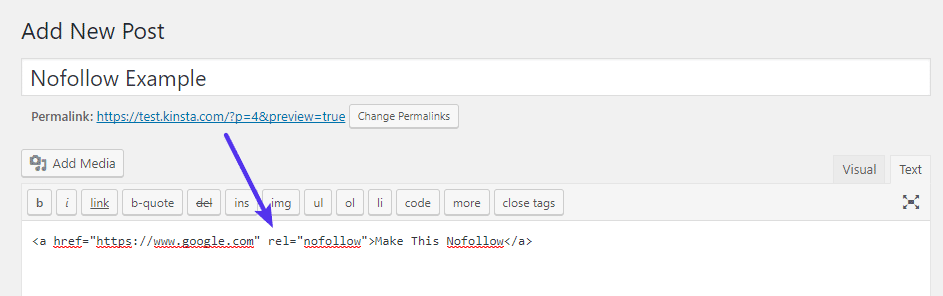 Image credit: Kinsta
The Changes to No-Follow Links
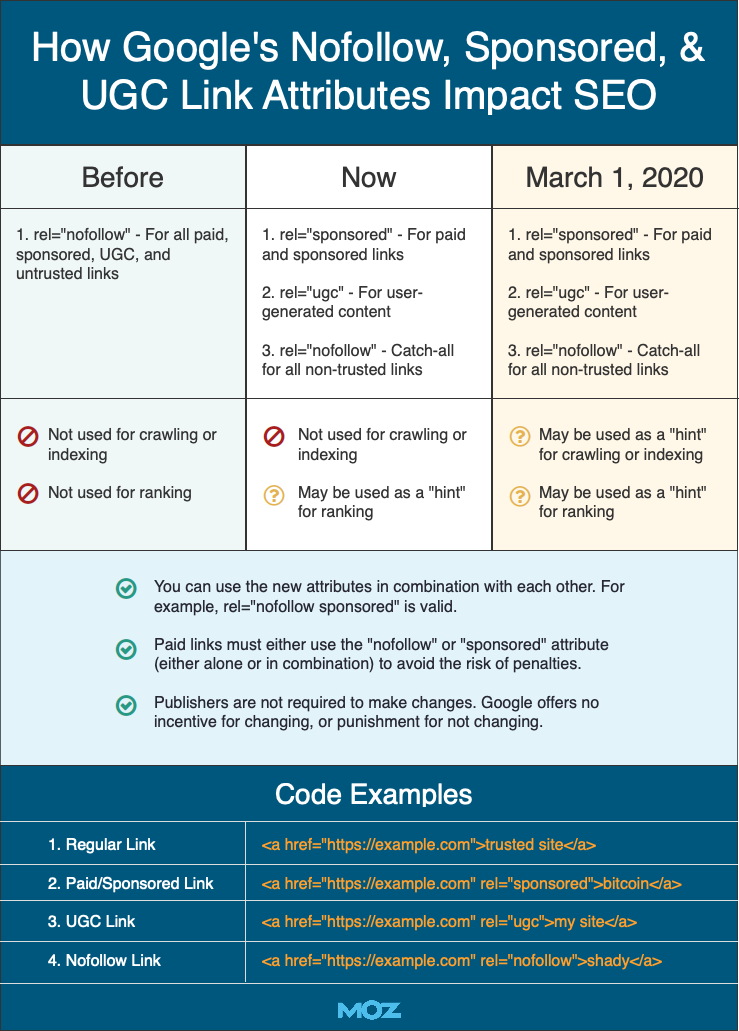
Now, there are two new link attributes: one for sponsored links and one for user-generated links. These will serve to provide Google with more detail about the content you’re linking to, rather than just marking them all as a generic “nofollow”.
Here are the three link attributes and how they’re meant to be used:
- rel=”sponsored”: use to identify links on your site that were created as part of advertisements or sponsorships (i.e. paid link placements)
- rel=”ugc”: recommended for links within user generated content (UGC), e.g. comments and forum posts
- rel=”nofollow”: use when you want to link to a page but don’t want to endorse it, or don’t want to pass along ranking credit to another page
Here’s where it gets more interesting: whereas previously, nofollow meant Google would ignore the link completely when determining search rankings, now nofollow may be used as a “hint” for ranking. And as of 1 March 2020, it may be used as a “hint” for crawling and indexing.
It’s said that these “hints” more or less just give Google the option to crawl the links and/or use them for rankings, if they so choose in the future – but there’s no guarantee of this ever happening.
Chart courtesy of Moz.
Action Items
Now, before you go frantically e-mail your Melbourne SEO agency about going back through old content and updating all your existing nofollow links, listen up: Google has stated that they wont be incentivizing or punishing anyone for not editing old links to include the new attributes. So just worry about properly forming all of your new links going forward.
Rock Solid Marketing is a digital marketing agency in Melbourne and Mildura that provides SEO services.Contact usto learn more about how to set your website up for SEO success!