If you’re familiar with Google Analytics and website metrics, then you know that bounce rate is one of the more important stats you want to be tracking – and that it’s something you want to lower over time.
And if you’re not, then you might be wondering what bounce rate even is. Well, allow us to explain and advise you on ways to improve your website’s bounce rate:
What is bounce rate?
Bounce rate is the percentage of people that leave a website after viewing just one page, rather than clicking through to see more.
The idea behind it is that if someone lands on a website and then closes it without clicking any further beyond the one page they started on, it may mean that the website wasn’t helpful – that the person didn’t find what they were looking for, or the content wasn’t quality, or it wasn’t relevant. All of these things are no bueno when it comes to getting your website to show up on Google. Because we all know that content is king, riiiiiiight?
Google wants to rank websites highly that provide quality content, bottom line. And if people are constantly bouncing from a website, then it indicates that perhaps the quality isn’t there.
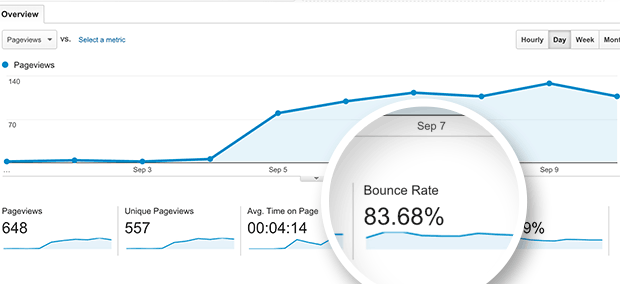
Source: optinmonster.com
Does bounce rate matter?
It sure does. In fact, SEMrush claims that it’s the 4th most important ranking factor for search engines.
Although Google’s algorithm may not directly look at bounce rate, this metric does indirectly impact search results because of what it implies: namely, that if a website has a high bounce rate, it may mean that the reader has not found what they were looking for, or did not find the website useful, since they didn’t linger and interact with the website beyond that one page they viewed. Consequently, Google’s RankBrain may take that to mean that the website should not be ranked highly.
What should your bounce rate be?
There is no exact number to aim for with your bounce rate, but in general: the lower the better.
According to Brafton, the average bounce rate is about 58%. However, bounce rate varies across industries – e.g. if a car website and a news website both have a bounce rate of 60%, it may be considered a good thing for one and a bad thing for the other.
It’s a good idea to segment before evaluating your website’s bounce rate – that is, breaking your site data down by age, gender, location, traffic source, etc, depending on who you actually want to target. This site details many different ways in which you can do this (under the ‘Modifying bounce rates’ section).
Source: DirectLync
How do you lower your bounce rate?
Heaps of ways!
- Determine which pages of your site have the highest bounce rate and work on improving those (in Google Analytics, go to Behavior –> Site Content –> Landing Pages)
- Speed up your website loading time
- Make it easier for visitors to find what they’re looking for (e.g. simplify your site structure, get rid of any distracting elements)
- Add internal links wherever relevant so that people can continue clicking through to read more on your website
- Add calls to action that prompt the user to click to another page on your site
- Use high quality images to attract and entice people
- Make it easy to read the text on your website (font size, font color, language, sentence structure, clarity, etc)
Above all: just make sure your website offers quality content! And if you still need help, find yourself an SEO company in Melbourne to work on optimising your website, such as Rock Solid Marketing.
Rock Solid Marketing is a digital marketing agency in Melbourne and Mildura that provides SEO services.Contact usto learn more about how to set your website up for SEO success!