Not too long ago, we wrote an article sharing some of our best blogging tips for new bloggers. This time, we figured we’d focus more on what you should do once you have your blog up and running.
With each blog post you write, you should always be thinking about two things: 1. How to make the article as interesting and engaging as possible (so that readers will be inspired to interact with and share it), and 2. How to optimise the article for relevant keywords (so it will show up in Google search results).
Here’s our best advice for tackling both of these:
Add Internal Links
Whenever relevant, you should incorporate links to other blog posts you’ve written – or even to other pages on your website. Think of it as if you’re a spider spinning your web. The more internal links you add, the stronger and more interwoven your website becomes. It’s a great way to get readers to click through your site and engage with other pages. More importantly, internal linking helps to spread SEO link juice throughout your site so that more pages are able to rank on Google.
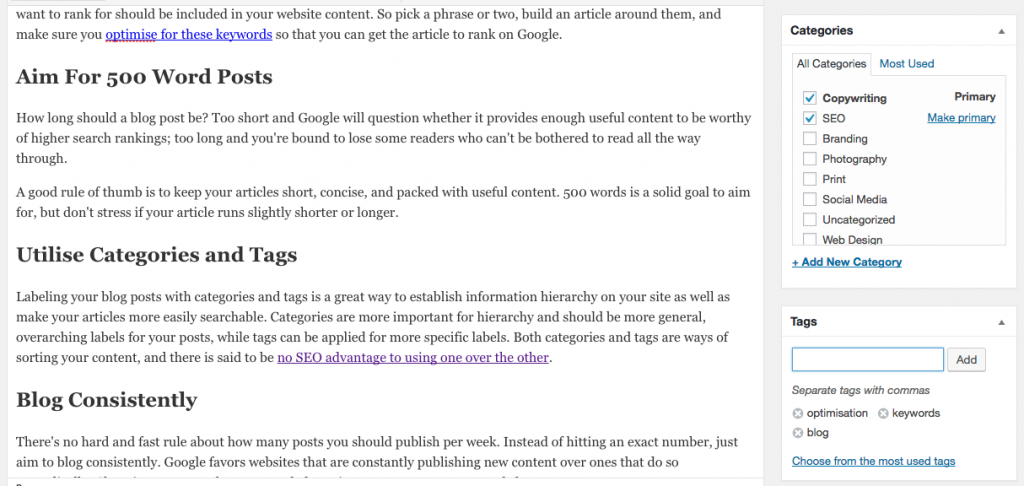
Categories vs tags for blog posts.
If you’re ever stuck for a blog post topic, consult your trusty list of keywords. It only makes sense that the keywords you want to rank for should be included in your website content. So pick a phrase or two, build an article around them, and make sure you optimise for these keywords so that you can get the article to rank on Google.
Aim For 500 Word Posts
How long should a blog post be? Too short and Google will question whether it provides enough useful content to be worthy of higher search rankings; too long and you’re bound to lose some readers who can’t be bothered to read all the way through.
A good rule of thumb is to keep your articles short, concise, and packed with useful content. 500 words is a solid goal to aim for, but don’t stress if your article runs slightly shorter or longer.
Labeling your blog posts with categories and tags is a great way to establish information hierarchy on your site as well as make your articles more easily searchable. Categories are more important for hierarchy and should be more general, overarching labels for your posts, while tags can be applied for more specific labels. Both categories and tags are ways of sorting your content, and there is said to be no SEO advantage to using one over the other.
Blog Consistently
There’s no hard and fast rule about how many posts you should publish per week. Instead of hitting an exact number, just aim to blog consistently. Google favors websites that are constantly publishing new content over ones that do so sporadically. Churning out several posts a week does give you more content to rank for,
Be sure to read Part 1 of Blogging Tips For New Bloggers!
Rock Solid Marketing is a Mildura and Melbourne SEO agency. Contact us if you need copywriting services or SEO services in Melbourne.