Search has changed more in the past two years than it did in the previous decade. With AI-generated answers, conversational interfaces, and zero-click results becoming the norm, traditional SEO playbooks are losing their edge. Ranking #1 on Google still matters—but it’s no longer the only (or even primary) goal.
Welcome to AI SEO!
If you’re a business relying on organic visibility to drive leads and revenue, this shift isn’t something you can ignore. The good news? The fundamentals of good marketing still apply. The difference is in how you execute.
What Is AI SEO?
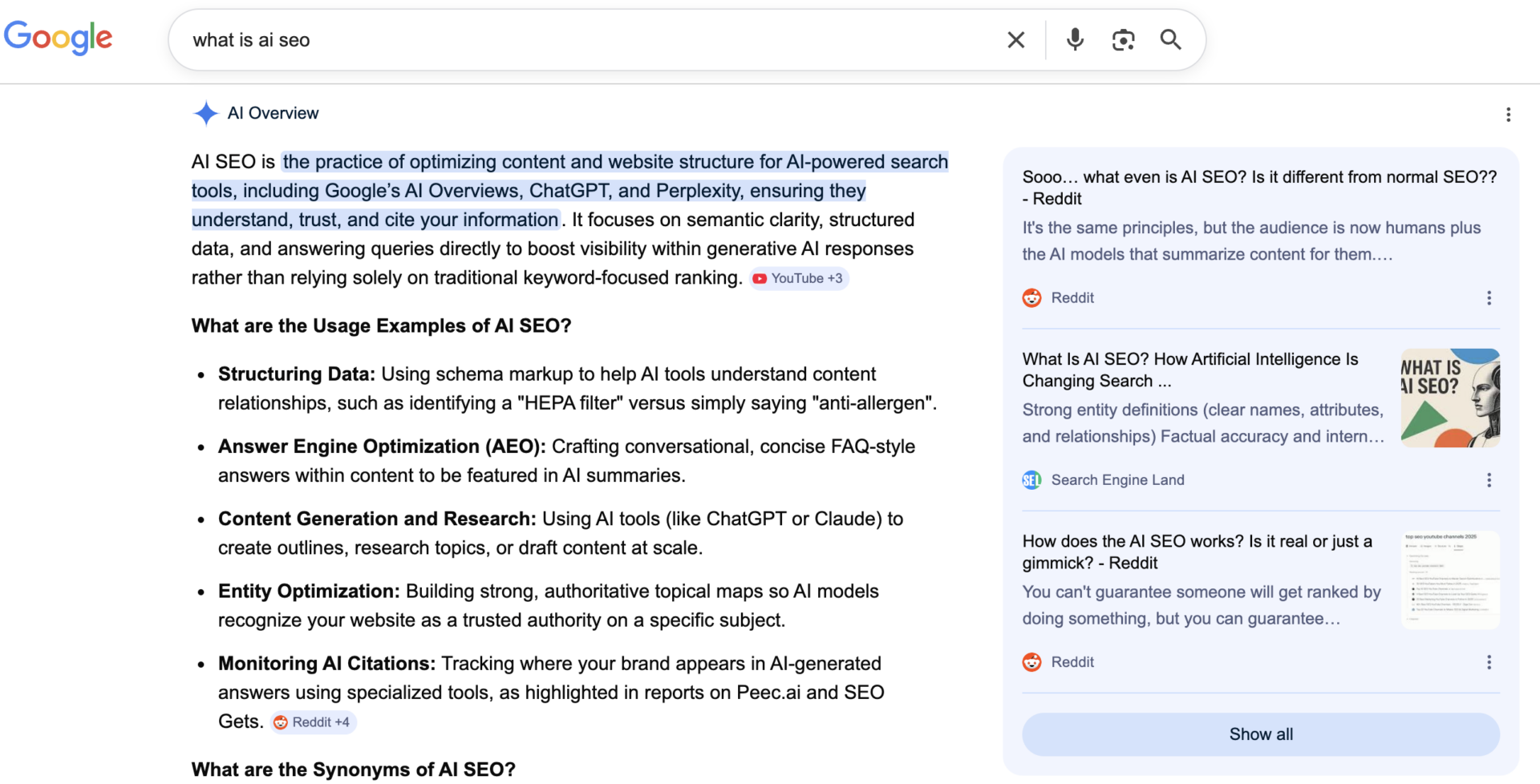
AI SEO refers to optimising your content and website not just for search engine rankings, but for AI-powered systems that summarise, recommend, and generate answers for users (e.g. Gemini, ChatGPT).
Instead of asking, “How do I rank #1 on Google?”, the question becomes:
How do I become the source AI trusts?
How do I get cited, referenced, or surfaced in AI-generated responses?
How do I show up when users don’t even click anymore?
The Death Of Clicks (As We Knew Them)
One of the biggest shifts in SEO is the decline of clicks. Users increasingly get what they need directly from search results without ever visiting a website.
This might feel alarming, but don’t worry – it’s not the full picture.
What’s actually happening is that clicks are becoming more intentional. When someone does click through, they’re often further along in their decision-making process. That means fewer, but higher-quality visits.
The takeaway? Traffic volume is becoming a less useful metric than traffic quality.
What AI Systems Actually Reward
AI doesn’t “rank” content in the traditional sense; it selects and synthesises it. To do this, it prioritises:
Clear, structured information – Content that is easy to parse, with clear headings, concise explanations, and logical flow, is far more likely to be used by AI.
Topical authority – One high-ranking blog post won’t cut it anymore. AI favours websites that demonstrate consistent expertise across a topic.
Credibility and trust signals – Author expertise, brand reputation, citations, and real-world experience all play a role in whether AI considers your content reliable.
Original insights – Generic, rehashed content is easy for AI to ignore. Unique perspectives, data, and opinions stand out.
How To Adapt Your SEO Strategy
If your current SEO strategy is still focused on keyword density and backlinks alone, it’s time for an upgrade. Here’s what actually moves the needle in an AI-first landscape:
Create “answer-first” content
Start with the question your audience is asking and answer it clearly within the first few sentences. Then expand. AI often pulls from concise, direct answers.
Build content ecosystems, not isolated posts
Think in terms of topic clusters. A pillar page supported by multiple in-depth articles signals authority and increases your chances of being referenced.
Bullet points, numbered lists, tables, and FAQs make your content easier for AI to extract and repurpose.
Strengthen your brand presence beyond your website
Mentions across the web – whether in articles, podcasts, or social platforms – reinforce your credibility. AI doesn’t just look at your site; it looks at your footprint.
The Rise of “Search Everywhere” Optimisation
SEO is no longer confined to Google. People are searching on TikTok, YouTube, Reddit, and AI chat interfaces. Each platform has its own algorithm, but the underlying principle is the same: useful, relevant, and engaging content gets surfaced.
For businesses, this means diversifying your content strategy:
Short-form videos that answer common questions
Long-form blog posts that establish authority
Thought leadership on platforms where your audience spends time
The brands that win are the ones that show up consistently across multiple touchpoints.
Measuring Success in AI SEO
Traditional metrics like search rankings and impressions still matter, but they don’t tell the whole story anymore.
Instead, focus on:
Qualified leads: Are the right people finding you?
Engagement: Time on page, scroll depth, and interactions
Conversions: Are visitors taking action?
Brand searches: Are more people looking for you by name?
AI SEO is less about visibility for its own sake and more about influence.
A Reality Check: What Won’t Work Anymore
Some tactics are fast losing effectiveness:
Mass-producing low-quality blog posts
Chasing exact-match keywords without context
Relying solely on backlinks for authority
Writing for algorithms instead of users
If your strategy feels like a numbers game, it’s probably outdated.
The Opportunity
Despite all the disruption, this shift actually rewards businesses that have something real and worthwhile to say.
If you have expertise, a clear point of view, and a willingness to invest in quality content, AI SEO levels the playing field. You don’t need to outspend competitors; you need to out-inform and out-help them.
Summary
AI isn’t killing SEO – it’s forcing it to evolve.
The businesses that adapt will stop thinking of SEO as a technical checklist and start treating it as a trust-building exercise. Because in an AI-driven world, visibility goes to the sources that are not just optimised, but credible, clear, and genuinely useful.
If your content does that, you won’t just survive this shift – you’ll benefit from it.
Rock Solid Marketing are experts in digital marketing in Mildura, offering SEO and web design services. Contact us to learn more about how to work with our Mildura AI SEO experts to set your website up for success!
About Rock Solid Marketing
Rock Solid Marketing is a trusted Mildura marketing agency servicing the Sunraysia and Mallee region since 2017.
If creating social media content feels like a full-time job, you’re right. It is! Coming up with ideas, writing captions, responding to comments, planning a content calendar, and keeping up with trends can quickly become overwhelming, especially when you’re already busy running a business. The good news is that you don’t have to start from
If you still think AI is mostly about writing blog posts or making weird images of astronauts riding horses, you’re missing the good stuff. The most useful AI tools for small business owners are not necessarily the flashy ones going viral on social media. They’re the quiet, practical, time-saving uses that eliminate annoying tasks, speed
Artificial intelligence (AI) has moved from buzzword to everyday business tool, but most small business owners still aren’t sure how to use it in practical ways. If that’s you, know that you don’t need to understand coding, automation systems, or complex software to benefit from AI. When used strategically, AI can help you create content